Wanzer windmill
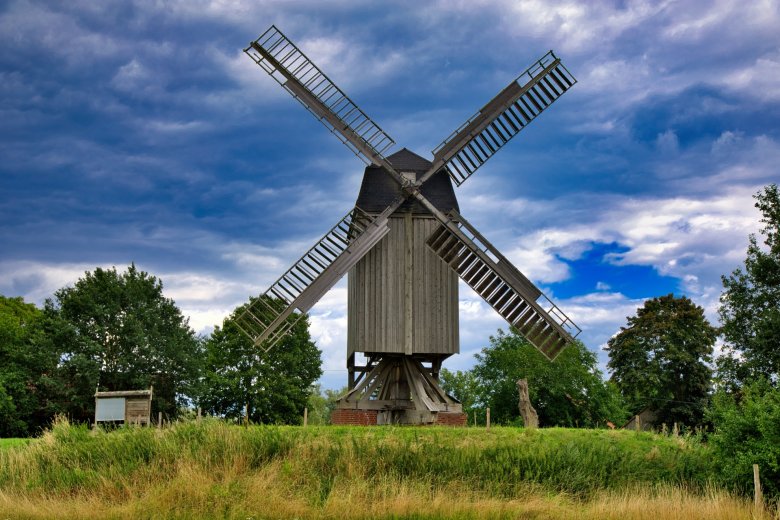
A mill site has been known to exist in Wanzer near Aland since 1611.
The "Martenmühle" was built by the Aulosen manor at the northern exit of Wanzer. The trestle was made of wood, and the oak frames of the wings were covered with canvas. The mill is said to have been struck by lightning several times, including on August 6, 1823. It was not until 1946 that this mill site was abandoned when the dilapidated structure was demolished. The last owner of the mill was Miller Marten. Marten was both a miller and a butcher. His wife, two sons, and two daughters helped him with his daily work. After his death, he was buried in the cemetery in Wanzer.
In 1868, a windmill was built near the village, which was in operation until the 1950s. It was located on a meadow at the southern end of Wanzer. The mill site also included a farmstead with residential and farm buildings. However, the property had lost its typical mill charm in recent years. Wild tree growth was encroaching on the area around the mill site. This had also changed the wind conditions so that the mill could no longer even be operated for show purposes.
This trestle windmill was built in 1805 in the neighboring village of Pollitz. It was also used there as a grain mill until the 1960s. The mill was then owned by the Theek family from 1880. The mill's brick trestle was boarded with wood. The wings were made of wood and the wheels inside were made of beech wood. The last miller of this mill was called Otto Theek. Müller Theek supplied the Wilke bakery in Wanzer with his flour for many years. Even in those days, baker Wilke drove around the villages in three cars and supplied the population with bread. In the 1950s, Müller Theek closed down the milling business as it was no longer profitable. With the formation of the agricultural production cooperatives in the GDR, the mill's historically grown clientele was lost. There was no question of modernizing the windmill during this time. The necessary materials were lacking.
Due to the lack of maintenance and many years of disuse, the mill was left to decay. A roof that was only in ruins and a badly damaged wooden structure led to irreparable damage. After reunification, there were several attempts to save the mill. There were interested parties who wanted to demolish the mill and rebuild it elsewhere, but this never came to fruition. Even 10 years after the fall of communism, a mill development association showed interest, but was put off by the now extremely desolate state of the building and the ownership situation. From 1880 until after reunification, the mill was owned by the Theek family and was then sold to a former German citizen. For the new owner, this purchase was "a tax-deductible investment". He also did nothing to stop the further decay and the theft of the wheels. So it continued to stand there sadly and the people of Wanzer seemed to have given up on it.