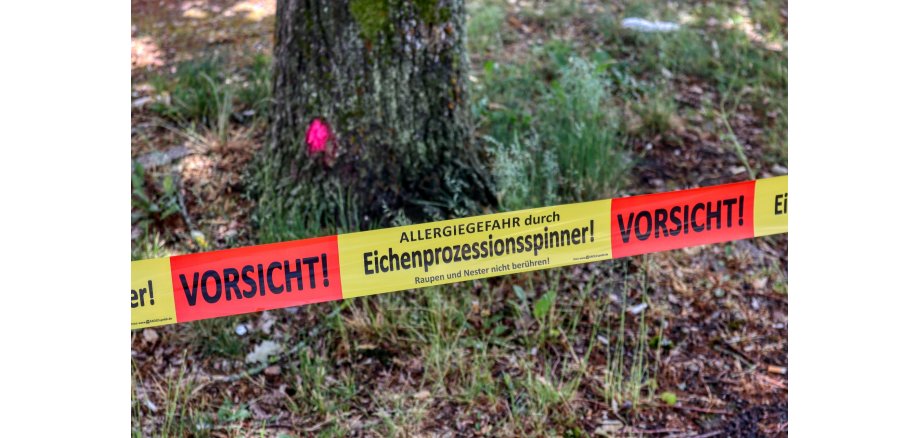
In Saxony-Anhalt, the population of the oak processionary moth (OPM)—which has been spreading in Germany since 1993—has risen sharply in recent years. It is most commonly found in warm, dry regions, particularly in open oak forests, at forest edges, and on sunny, isolated trees; however, there has also been an increasing number of severe infestations in public green spaces and gardens. In the Stendal district, extensive efforts have been made to combat it for many years, though the measures cannot be 100% effective—as is the case this year as well. They can therefore pose a health risk to humans. For this reason, the district administration expressly advises the public to take precautions and follow certain guidelines.
Special caution is advised regarding the caterpillars’ hairs. Starting in the third larval stage, the caterpillars develop toxic hairs that contain the protein toxin thaumetopoein. Around late May/early June, when the toxic hairs form, the caterpillars spin nests in sheltered spots on the trunks or branches of oak trees. The toxic hairs can be carried up to a thousand meters by the wind. Starting in July/August, the caterpillars pupate, and three to six weeks later, the moths emerge. Old web nests, whether clinging to the tree or lying on the ground, pose a continuing danger, as the caterpillar hairs have a long shelf life.
In the district of Stendal, efforts to control the oak processionary moth have been carried out on a similar scale in all municipalities and municipal associations for years. An increased presence is currently evident in the municipal area of the Seehausen association of municipalities, the single-municipality town of Tangerhütte, and the Hanseatic City of Stendal. Therefore, the following precautions and guidelines must be observed: As a general rule, infested areas should be avoided, and warning signs and closures must be heeded. Caterpillars and webs should not be touched. If contact has occurred, take a shower with shampoo and change clothes immediately. Clothing, including shoes, must then be washed at 60 degrees Celsius and should not be brought into the living area. Eyes should be thoroughly rinsed with water. As a precaution, sensitive skin areas should be protected. These include the throat, neck, and forearms.
Contact with the caterpillar hairs can cause a wide range of symptoms. Allergic reactions are possible; the most commonly reported symptoms are localized skin rashes with small, red spots, accompanied by severe itching and a burning sensation. These skin symptoms subside after a few days without requiring specific treatment. Irritation of the mouth and nasal mucosa, coughing, and bronchitis may also occur due to inhalation of the hairs. In very rare cases, dizziness, fever, fatigue, and conjunctivitis may occur. If allergic symptoms, eye conditions, or severely itchy skin conditions become more pronounced, consult the appropriate specialists. During treatment, contact with the caterpillar hairs should be discussed.
The owners or other authorized representatives of the properties on which trees infested with the oak processionary moth are located are always responsible for monitoring, prevention, and control measures. If there is a potential health risk to people, they must—as part of their duty to ensure public safety—take appropriate measures to mitigate the risk at their own expense. These include, in particular, chemical, biological, and mechanical control measures.
Anyone who notices an acute infestation in a public place should report it to the relevant public order office of the respective municipality or unified municipality.
The municipalities in the Stendal district generally offer private owners of oak trees infested with the European spruce bark beetle (ESBB) the opportunity to join the control measures against the ESBB. This offers a significant cost advantage for private owners. A call for participation is issued annually in August for the following year. Reports should be submitted to the relevant municipality or association of municipalities. The Stendal district commissions only certified and licensed pest control operators. Anyone who discovers an active infestation in public areas should report it to the relevant public order office of the respective municipality or association of municipalities.