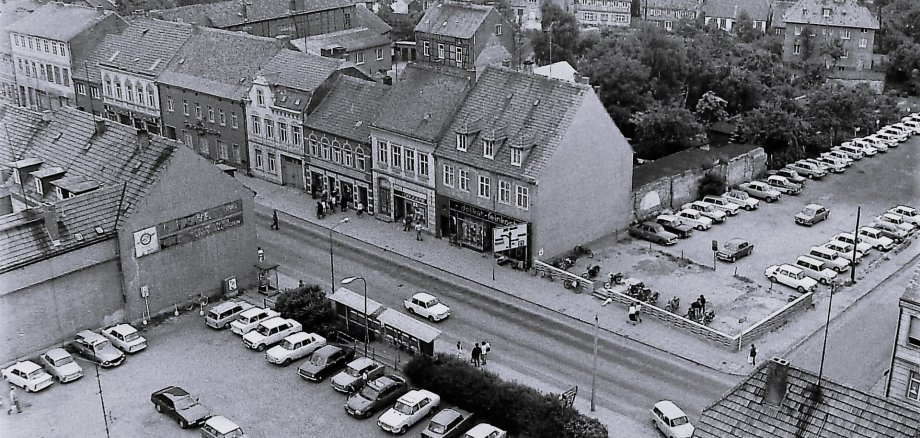
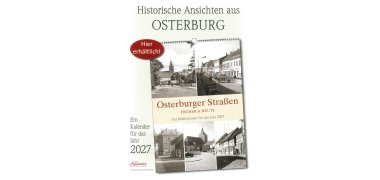
The District Museum now invites visitors to experience the changing times in the Hanseatic city of Osterburg. The new 2027 calendar is titled “Views of Osterburg’s Streets—Then and Now.” It is based on the exhibition of the same name, which is on view through August 16 at the museum located at Platz des Friedens 3 (39606 Hanseatic City of Osterburg). Priced at 22.90 euros, the calendar is available at the Osterburg District Museum and at the office supply store Engels (Breite Straße 11).
“For the exhibition and calendar, some historical views were rephotographed specifically from the same perspective,” explains Florian Fischer. “This creates fascinating ‘aha’ moments that make the many changes—right up to the present—visible,” says the director of the Osterburg District Museum. The images and information were produced, compiled, and scientifically documented by him and his team in collaboration with the two local historians, Lothar Müller and Jörg Gerber.
In addition to the pairs of images, the calendar features interesting facts about Osterburg’s history. For example, as late as 1780, the Great Market was still called “Rademarckt” and served as a venue for livestock and annual fairs. Today’s Breite Straße—once part of the important trade route from Magdeburg to the Baltic Sea—was settled by Rhineland and Saxon settlers starting in 1170. And on a map from 1780, Kirchstraße still consisted of four separate sections, each with its own name: “Schöppenstuhl,” “Am Kirch Hofe,” “Spangenstraße,” and “Dammstraße.”
The Osterburg County Museum is open Tuesday through Friday from 1:00 p.m. to 4:00 p.m. and on Sundays from 2:00 p.m. to 5:00 p.m. It is accessible via the inner courtyard.